
What exactly is a munchkin?
One of my teen students once reminded me how radically context can shift a word’s default meaning. During a break she asked me what “munchkin cats” had to do with donuts, which gave me a delightful moment of perplexion until I figured out that for someone raised in Massachusetts the baseline meaning of munchkin might be a donut hole As far as the historical record shows, the word enters modern English in 1900 with L. Frank Baum’s The Wonderful Wizard of Oz, where Munchkins are the people of Munchkin Country. But the word has no traceable path before Baum: he never said where he got it or why he made it, and there is no secure pre-Oz history that explains it. Even so, it is clearly treated as a word meaning something little—not only because that is how it functions in The Wonderful Wizard of Oz, but also because modern speakers naturally parse the ending -kin as a diminutive suffix, that suggests smallness or endearment.
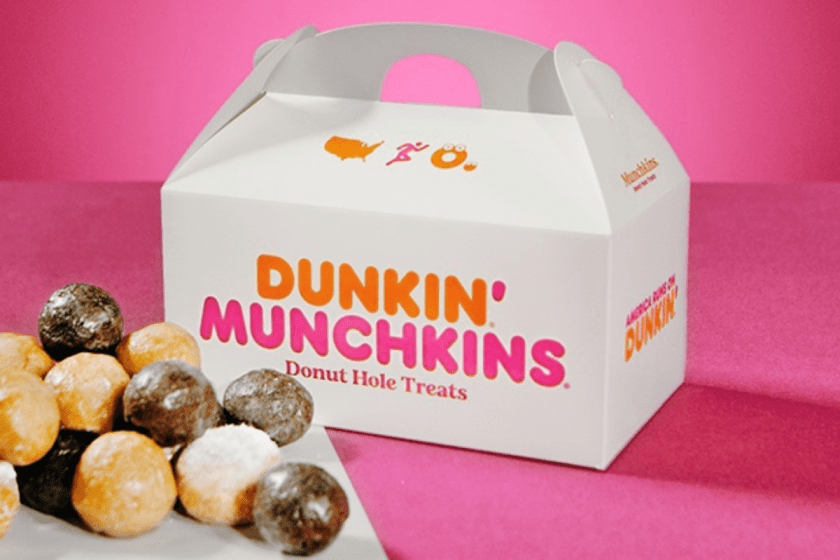
A productive suffix is one that speakers can still freely use to make new words. In Modern English, if we want to make something sound smaller or more familiar, we are more likely to reach for -ie / -y , as in “doggy”, “kitty”, or “sweetie”. But earlier forms of English had another productive suffix -kin which was part of a much broader pattern across the Germanic languages. In Modern English, remnants of it appeare in several spellings via multiple routes of transmission. especially from Dutch and from French words borrowed from Dutch. For example, the word “mannequin” appears French in spelling but the word goes back to Dutch manneken , meaning “little man.” Similarly, the word “ramekin” comes from Dutch rammeken which meant “small cream.”
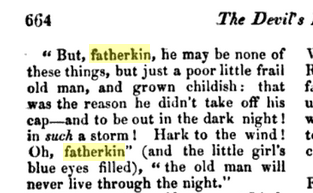
Lots of words in Middle English and early modern English used -kin as a diminutive suffix meaning “little” or “dear.” Forms like fatherkin were once common enough to feel natural, though many of these words have since lost purchase. Some survive better than others: people may still recognize lambkin as a term of endearment. The word “napkin” derives from nape, meaning “tablecloth,” so napkin originally meant a little cloth. Diminutive forms have also settled into specialized corners of English: catkins are soft, furry flowering spikes on trees such as willow and birch. This word comes from Dutch katteken, meaning “little cat” or “kitten,” and was applied to the flower cluster by resemblance.
Resemblance is a trickster in language history because speakers reshape words by analogy, not by historical rule. Speakers are not archivists of a language but its users, and they make a great deal of it on the fly according to how they understand the version of the user manual available to them. Through reanalysis, folk etymology, and standardization of writing, a form can be remodeled to fit a pattern that feels natural at the time. The word “checkmate” is a good example of a word following a trajectory of speaker interference. The word “checkmate” is a good example of a word following a trajectory of speaker interference. By the mid-1300s, English had borrowed checkmate from Old French eschec mat, itself from Arabic and ultimately Persian shah mat. Once speakers began hearing checkmate as made up of the meaningful English words check and mate, those elements started to reorganize the word from within. Check could now be understood as the threatening move, mate as the finishing one, even though the word did not enter English as a native compound with those meanings built into it.
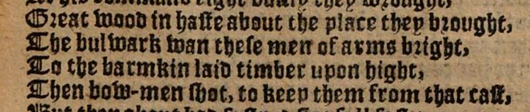
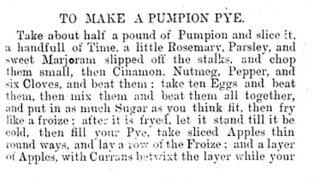
Words ending in -kin are often difficult to sort out, and that is why so many competing etymologies appear around them. A good many words contain kin but may come from several different sources. “Barmkin”, for example, is a type of fortification, and it derives from an earlier form barnekyn, but the origin of the suffix is obscure. It is widely speculated that “barmkin” could be a modification of the word barbican which meant a fortified perimeter but this is due to sense and not record. The word “pumpkin” exhibits another type of -kin ending, one that grew over time. Earlier English had forms such as pompion and pumpion, borrowed from Old French forms. The later spelling pumpkin seems to have been reshaped by assimilation to other English words in -kin rather than formed as a true “little” word. The same caution applies more broadly: not every English word that looks as though it contains the suffix actually does, and sometimes the resemblance is the result of later spelling, borrowing, or analogical assimilation.
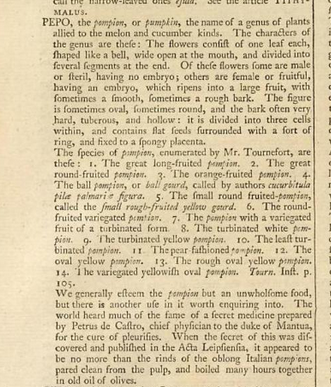
Or, Universal Dictionary of Arts and Sciences. In Two Volumes. Published 1753.
Alongside diminutive -kin, Old English also used this suffix in the sense of “kind, lineage, or race”, visible in compounds such as Angelcynne, hellecynne, cyningcynne, and ælfcynn. That is the older –kin that continues into modern English forms like “mankind”, “humankind”, and “elfkind”, and it also lies behind more recent formations such as demonkin, dragonkin, and otherkin, where the sense is “of a kind” or “belonging to a class.”
The difficulty herein is that productive suffixes belong to the world of spoken language, of which written evidence is thinner further back in time. Attestations to individual forms are often scattered and incidental, so it can be difficult to determine from small written traces exactly what pattern of resemblance speakers may have been following.
Furthermore, forms pass through different spelling systems, and differences in prestige affect not only how words are written down or described, but which words get written down at all, which can shape later assumptions about where those words are thought to have come from.
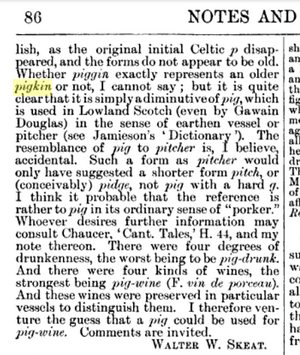
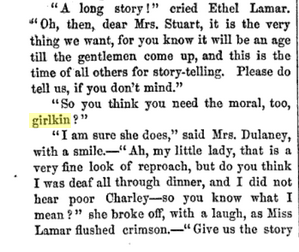
This is a good reminder that language exists in the head, not on the page. English speakers in any period process words through the patterns available in their own version of their languages. A form like “pipkin”, which is both a surname and the name of a small pot, may still strike a modern speaker as sounding cute because -kin retains a diminutive feel. “Calkin”, by contrast, could be processed quite differently, perhaps as the name of a film star or as a verb form with the final –g dropped. The word”Girlkin”, although in use through the early 1900s, may be harder for contemporary speakers to parse, while “girlykin” might be much to hear as intentionally formed.
Etymology is a fascinating pursuit, but often an inconclusive one. With forms like these, resemblance muddies the record so thoroughly that exact pinpointing is often the wrong goal; what matters more is recovering the general shape of the pressures speakers were responding to. This tangled ecosystem of inheritance, analogy, and reinterpretation is what leaves language with delightful nuggets in unexpected corners, such as the word “ladykins” which turns up, perfectly legible and alive, in the modern American drag scene.